Interview About the Updates to the
“Medium-term Management Plan 2027”

- Q. On May 8, 2025, the Medium-term Management Plan 2027 announced on May 9, 2024 was partially updated. Could you please share the background behind this update? First, please tell us about the reasons for revising the target of opening a cumulative total of 30 stores during the period of the Medium-term Management Plan (a three-year plan from FY2025 to FY2027), to a cumulative total of 20 stores.
- Hiramoto: Store opening costs are currently on the rise and are unlikely to decrease going forward. In light of this situation, the Company has decided to tighten and examine our store opening standards more strictly than ever before to maintain a reasonable pace for new store openings. As a result, we have revised our plan from opening 30 stores over three years to opening 20 stores over the same period. This also forms a part of our “Gambaranai Keiei” approach. However, this does not mean that we have adopted a passive stance. We will rebuild the formats in a way that is aligned with the persistently high store opening costs, as we continue to explore store formats that are suited to each region. Furthermore, we will proactively carry out store refurbishments that were postponed during the COVID-19 pandemic. While these refurbishments are clearly aimed at boosting sales, they are also essential for keeping up employee motivation, allowing them to work in a clean and pleasant store.

- Q. Cash allocation was also updated in line with the change in store opening plans. Could you please explain the rationale behind this?
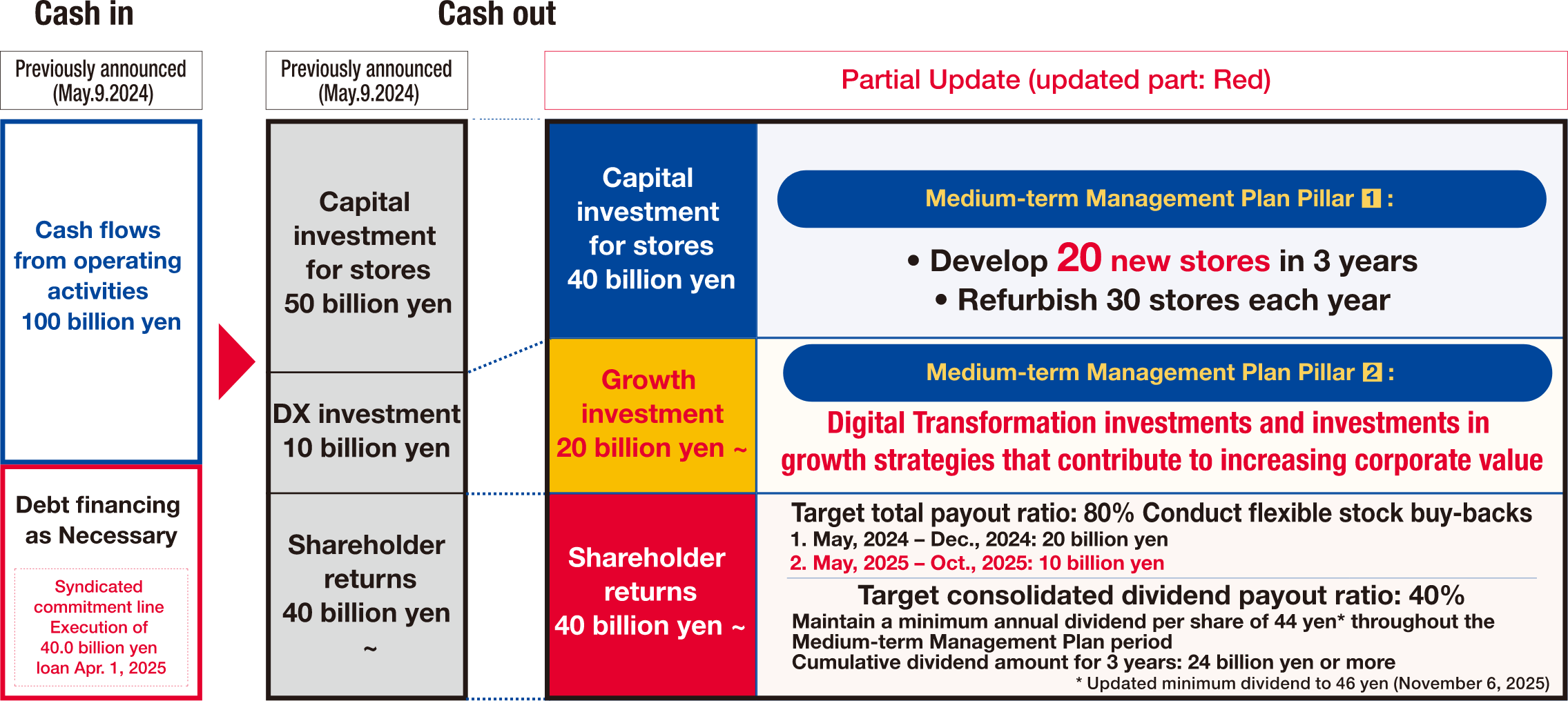
- Hiramoto: Regarding the cash outflow component, we have updated our capital investment for stores from 50 billion yen to 40 billion yen due to the slower pace of new store openings.
We have also allocated 20 billion yen to growth investment. While we had previously planned to invest 10 billion yen in digital transformation (DX), we will boost this DX investment with a view to accelerating the push to increase online store sales, in order to compensate for the reduction in store openings. We intentionally chose the term “growth investment” to reflect our commitment to exploring an optimal growth strategy for the Company, including human capital investments and other options. Particularly with regard to human capital, we will invest in education that contributes to enhancing customer service skills, as well as in recruiting and training personnel involved in DX initiatives.
Excerpt from Medium-term Management Plan 2027 (Published May 9, 2024, partial update published on May 8, 2025)
- Q. Last but not least, could you tell us about the Company’s stance on shareholder returns?
- Hiramoto: The Company is also engaged in efforts to support asset formation among employees, and our Employees’ Shareholding Association is positioned as the Company’s second-largest shareholder. In fact, the ownership of company stock by employees also lies at the root of our ability to achieve significant growth. Upon witnessing skilled employees resign in succession to start their own businesses shortly after the Company’s founding, our founder Kaoru Kato wanted to find a way to retain them over the long term and enable them to build up their assets by working for the Company. He conceived the idea of establishing a joint-stock company with investment from the employees, but employees lacked substantial personal funds. In light of that, Kato first had all employees resign and paid them severance, which they then used as seed money to purchase shares in the Company. Thus, the joint-stock company was established with employees contributing 50% of the shares and founder Kaoru Kato contributing the remaining 50%. With this background, we now provide generous subsidies to the Employees’ Shareholding Association. When employees hold shares in the Company, they will naturally begin to pay more attention to its stock price and profit or loss position as they work. I believe this is a good system.
- Given this history, the Company positions shareholder returns as one of its key management policies, and places great importance on it.
- Specifically, we implemented a 20-billion-yen share buyback in FY2025. Then, starting in May 2025, we conducted a 10-billion-yen buyback. Combining these share buybacks with approximately 24 billion yen in dividends over three years makes a total of 54 billion yen. However, as we have announced shareholder returns in the range of over 40 billion yen, we will allocate the funds flexibly while monitoring equity capital, so as to achieve our target ROE of 8%.
- We recorded a significant impairment loss in FY2025, and we have factored an impairment loss into our plans for FY2026. However, considering the trends in our underlying profitability and our financial position, we expect to be able to continue generating solid operating profit going forward. Therefore, the shareholder return policy has remained unchanged.
- We will continue to work toward achieving our target total payout ratio of 80% and consolidated dividend payout ratio of 40%.