

Progress status of
“Medium-term Management Plan 2027”

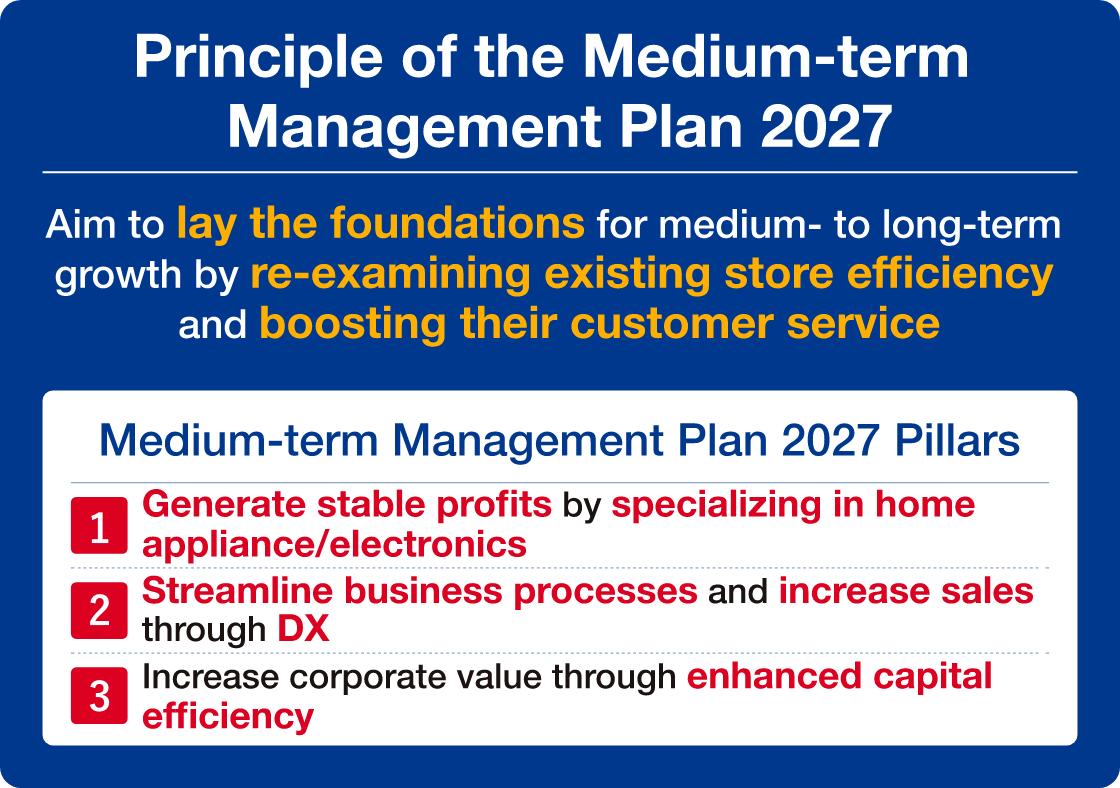
- Q. Concurrent with your appointment as President at the General Meeting of Shareholders held in June 2024, the Medium-term Management Plan (a three-year plan covering FY2025 to FY2027) commenced, with FY2027 as its final year. The first year of this plan has now concluded.
Please share an update on the progress of efforts to date. First, could you tell us about the external environment? - Yoshihara: During FY2021, which was right in the midst of the COVID-19 pandemic, provided a positive boost to our Company. While many businesses struggled with poor performance, K’s Denki, which deals in home appliances/electronics, unexpectedly achieved record-high profits on the back of factors such as extended periods of staying home, remote work, and the advantages of our suburban-type stores. Although both sales and profits fell in the subsequent three years due to a reactionary decline from pent-up demand and a boom in experience-based consumption such as travel, the backlash subsided by FY2025 and our results finally bottomed out and took a turn for the better. Consequently, we achieved increases in both sales and profits in FY2025, for the first time in four fiscal years.
- Meanwhile, recent rising prices and energy costs have heightened the consumer mindset of protecting their livelihoods, leading to a sustained trend toward thriftiness. Home appliances/electronics are necessities for our daily lives, so there is solid demand for replacements when items no longer work. However, the replacement cycle appears to have slowed in recent years. Consumer mindset is undergoing a shift from “It’s about time to replace it with something new,” to “I have no choice but to buy a new one since it’s broken.”
- This is precisely why our Company must firmly capture this replacement demand. When interacting with customers, it is crucial for us to recommend “high value-added products” that offer high functionality and superior energy efficiency, a key initiative that we have incorporated as a key measure in our Medium-term Management Plan.
(Published May 9, 2024, partial update published on May 8, 2025)
- Q. Looking back on FY2025, please share the status update of Pillar 1 of Medium-term Management Plan 2027, “Generate stable profits by specializing in home appliance/electronics.”
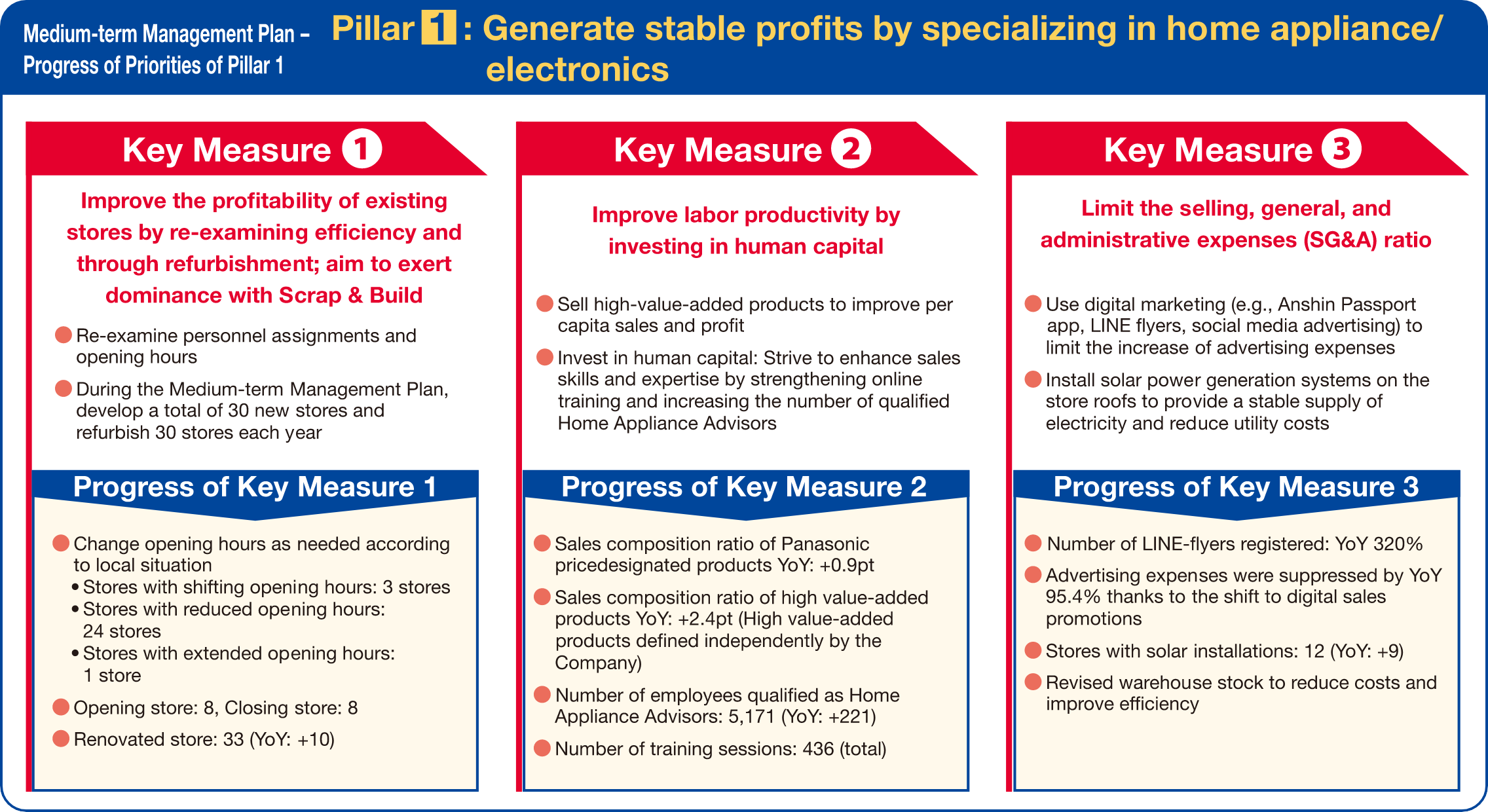
- Yoshihara: First, with regard to the progress status for Key Measure (1), we adjusted business hours as needed according to the local situation. This review is ongoing and undertaken as appropriate. There are three stores with shifted opening hours, 24 stores with reduced opening hours, and one store with extended opening hours. We are working to align our opening hours with trends in customer behavior and the surrounding commercial facilities and residential environment.
Next, looking at store openings and store closures, we opened eight new stores. While our three-year plan to open 30 stores implies a simple average of 10 stores per year, persistently high construction costs have resulted in fewer store openings than planned. We closed eight stores, including some as part of our effort to re-examine the efficiency of existing stores. After carefully considering multiple factors, we closed the stores in cases where we determined that closure would lead to improvements in overall efficiency.
We completed the renovation of 33 stores, exceeding the target. Renovation is extremely important. In addition to enhancing customer convenience by rezoning sales areas in line with the trends to maintain the appeal of sales floors, adding rest spaces, and installing information counters, among other measures, refurbishment also helps to motivate employees by providing a pleasant, clean workplace. We will continue to implement such renovation consistently going forward. - The next point concerns the progress of Key Measure (2), which includes the important measure of selling high value-added products. However, there is something I must mention before that. Since the Company’s founding, we have always placed the utmost importance on our employees. Accordingly, we have consistently provided base salary increases every year. While we intend to keep up this practice going forward, personnel expenses have been accounting for an increasingly growing proportion of our SG&A expenses year after year, as is likely the case with many companies.
Our Company has established “Gambaranai Keiei” as our management policy. To explain this concept in simple terms, management is an endless “ekiden” (Japanese road relay), so it would be meaningless to push oneself too hard only at certain moments. This means doing what needs to be done properly, but not attempting to do what you cannot possibly accomplish. For this reason, we do not impose sales quotas on our employees. We listen carefully to our customers and do not pressure them to buy products that are profitable for the company. Adhering to this principle has helped us to earn our customers’ support and gained more fans. This management policy is a top priority for our Company, and I feel that we must continue to abide firmly by it going forward. To that end, we have to continue with efforts to improve labor productivity.
Even with online shopping becoming a widespread trend these days, our Company continues to operate brick-and-mortar stores where people provide customer service. When I consider what the value of such physical stores is, I believe that a store’s value can be equated to the service skills of its employees. If we were selling products that are simply handed over to customers when they say, “I’ll have this please,” we could do that without human staff. The value of our existence lies in our employees themselves. When people are involved in providing customer service, they introduce customers to other products with convenient features. We must recommend such products properly, explaining that purchasing them will offer further usage value. This does not contradict the “Gambaranai Keiei” philosophy that we have emphasized since our founding. Introducing better products and recommending more convenient options to enhance customer satisfaction is not deceiving customers to make a sale; rather, I believe that it leads to genuine improvements in customer satisfaction.
For example, washing machines range from items that cost 50,000 yen to 300,000 yen. The proportion of people buying the 300,000-yen model is not that high. However, by increasing this buyer ratio from one in 20 to two in 20, it will be possible to raise labor productivity per person. Selling a 300,000-yen product does not require customer service lasting six times longer than selling a 50,000-yen product. Therefore, by increasing the sales proportion of what we describe as “high value-added products,” we will be able to continue raising labor productivity going forward.
To achieve this, we first need to enhance employees’ knowledge so that they can recommend products confidently. To that end, we support employees in acquiring the Home Appliance Advisor certification, enabling the successful certification of 221 more employees than in the previous year. We also conduct training sessions frequently, with a total of 436 sessions held. As a result, we increased the sales composition ratio of high value-added products by 2.4 percentage points compared to the previous year. - Moving on to the progress of Key Measure (3), we are advancing efforts to use digital marketing and have seen a jump in the number of LINE flyer (smartphone app) subscribers by 320% year on year. The combination of print advertising with efficient digital marketing tools has contributed to reducing advertising expenses to 95.4% of the amount last year. Additionally, the number of stores with solar power systems installed has increased by 9 stores from the previous year, reaching 12 stores. These initiatives have helped to improve profitability at some stores.
Excerpt from Medium-term Management Plan 2027 (Published May 9, 2024, partial update published on May 8, 2025)
- Q. Next, could you share an update on the progress of Pillar 2 “Streamline business processes and increase sales through DX?”
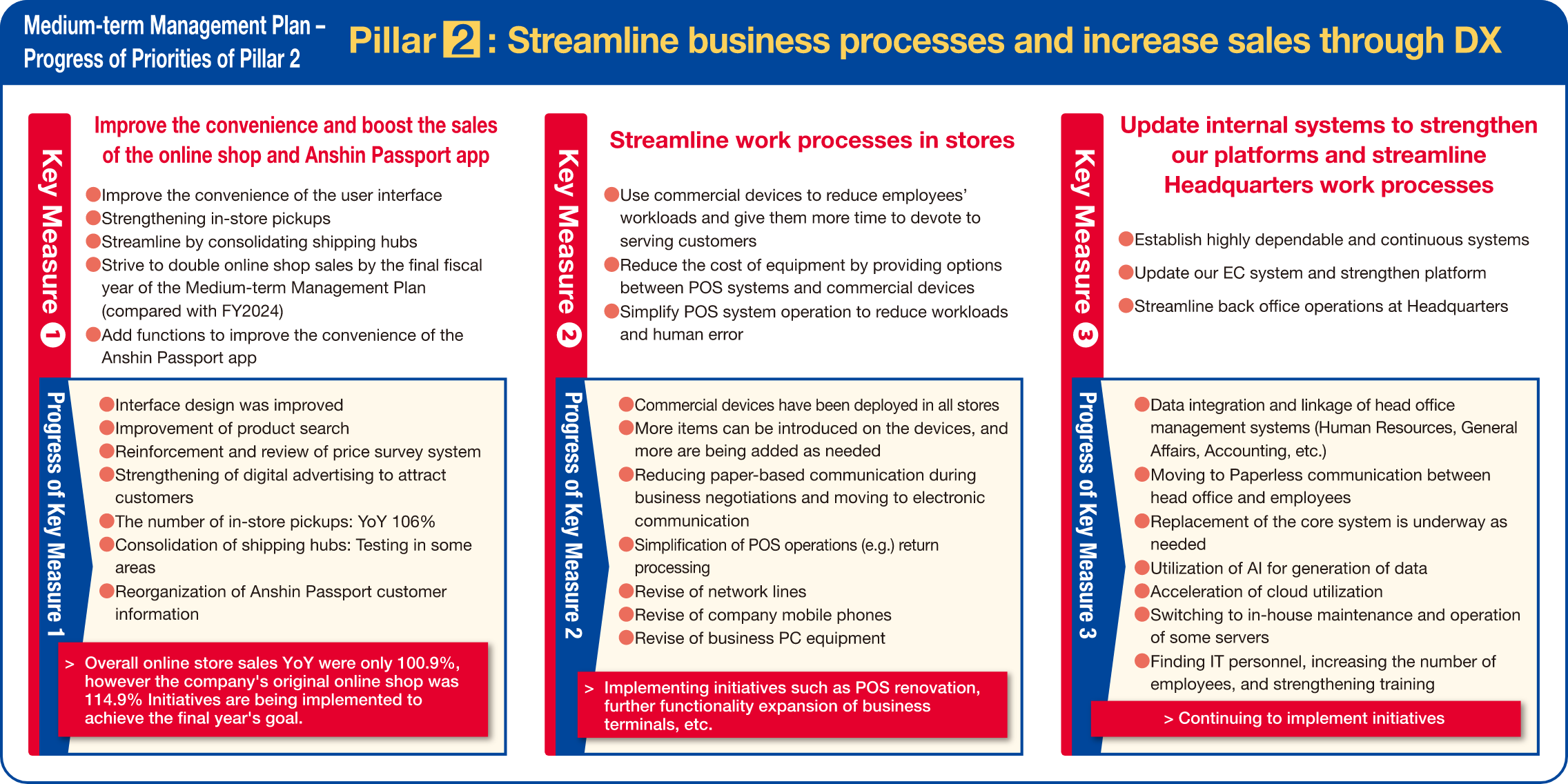
- Yoshihara: Regarding the progress status of Key Measure (1), we enhanced the usability of the online shop by improving its design and product search functions. We also reinforced our price survey system, making improvements from the aspects of ease of use, product lineup, and price. The number of in-store pickups was 106% compared to last year. Thanks to our initiatives, overall in-house site sales were 114.9% compared to the previous year, although online store sales remained at just 109% year on year. By advancing efforts such as consolidating shipping hubs, which we are currently testing, I believe the results will begin to bear fruit going forward.
- As for Key Measure (2), we are constantly adding items that can be introduced on business-use devices as needed. Furthermore, reviews of in-house network connections, company mobile phones, and business PC equipment have helped to reduce costs.
- Regarding Key Measure (3), we are striving to enhance efficiency by promoting data elimination and integration, as well as linkages, in the areas of human resources, general affairs, and accounting. We are also moving to paperless operations and advancing greater utilization of cloud and AI tools.
Excerpt from Medium-term Management Plan 2027 (Published May 9, 2024, partial update published on May 8, 2025)
- Q. Next, please provide an update on the progress of Pillar 3 “Increase corporate value through enhanced capital efficiency?”
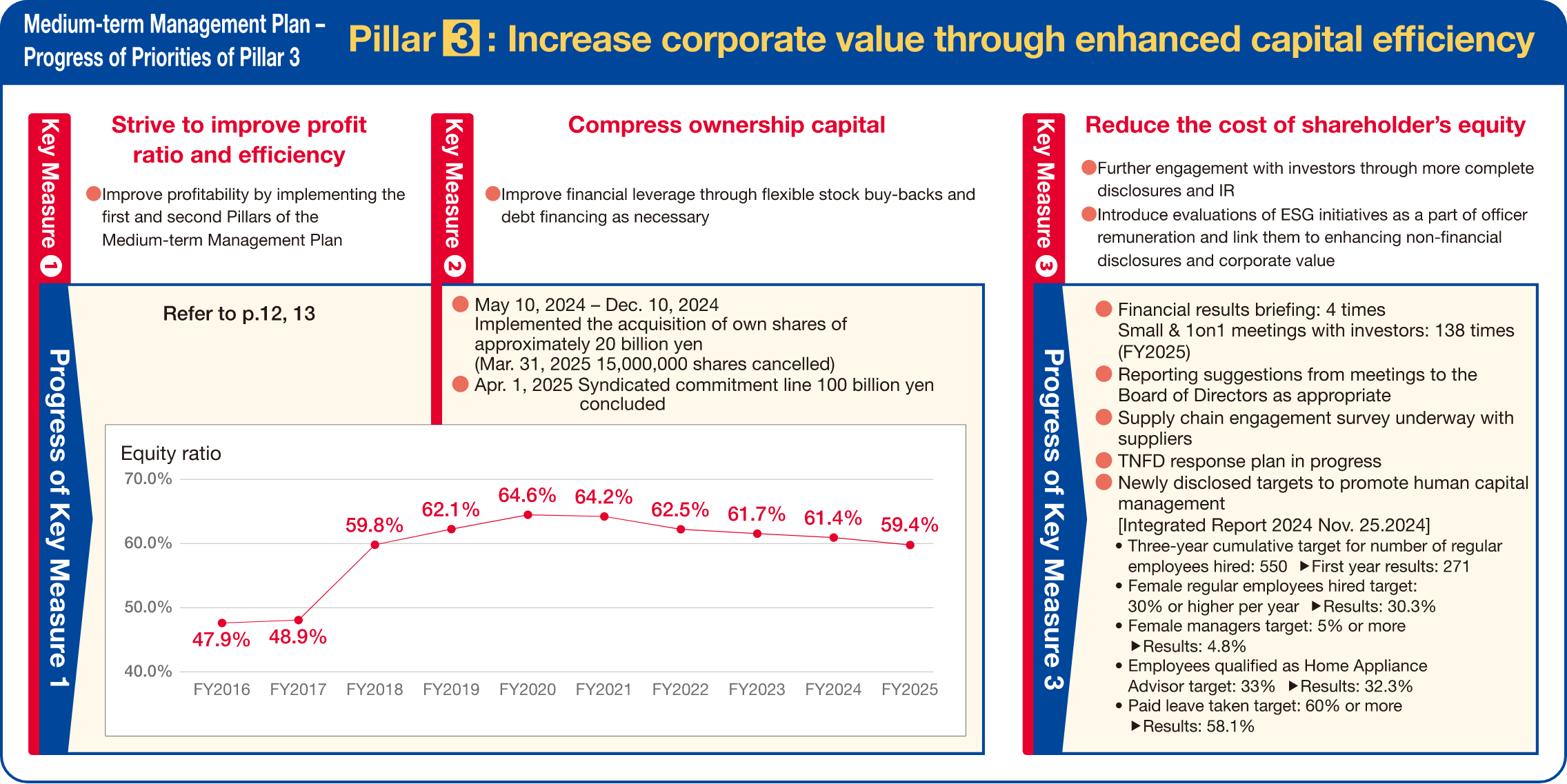
- Yoshihara: For Key Measure (2), we implemented share buyback of approximately 20 billion yen in FY2025, which resulted in equity ratio of 59.4%.
Regarding Key Measure (3), we actively engaged in dialogue with shareholders, holding a total of 138 meetings throughout the year. The feedback and opinions received are reported to and shared with the Board of Directors, stimulating discussions on future growth strategies.
In the area of ESG, in light of the importance of human rights and compliance, we conducted a supply-chain engagement survey with our business partners. We received responses to the CSR Procurement Self-Assessment survey from business partners who represent approximately 70% of our procurement spending. (Refer to p.55) We are also advancing preparations for TNFD, biodiversity-related response, and related disclosures.
Regarding human capital, we are promoting initiatives toward the newly established Group-wide targets set out in our Integrated Report 2024. Notably, we achieved 4.8% for the ratio of female managers, targeted at 5% or higher, representing an increase of 0.8 percentage points from the previous year. (Refer to p.39 and 42.)
Excerpt from Medium-term Management Plan 2027 (Published May 9, 2024, partial update published on May 8, 2025)
- Q. Last but not least, what are your views on future demand?
- Yoshihara: By specializing in home appliances/electronics, the Company has enhanced its expertise and generated high profit margins. On the other hand, this makes us more susceptible to the impact of the external environment. Some external factors that affect management in the short-term are caused by unusual weather patterns (cool summers, warm winters), but many summers in recent years have seen abnormally high temperatures. As such, air conditioners and other seasonal products crucial for the sustenance of life, have solid replacement demand and are selling well. Household penetration rates remain low particularly in areas such as Hokkaido and northern Tohoku. K’s Denki, which holds a relatively high market share in the Tohoku region, can anticipate continued demand growth there. However, the sales channels through which consumers can purchase home appliances/electronics have expanded beyond just home appliances/electronics retailers to include “home centers” (hardware stores), furniture stores, discount stores, TV shopping, and online retailers. This is precisely why we must continue to practice genuine kindness that resonates with our customers, ensuring that they will choose K’s Denki when they need to replace their home appliances. By doing so, we will steer the Company toward achieving the goals of the Medium-term Management Plan 2027.